
Pulaski County Court Calendars Explained
A court calendar lists future events. That is all it does. In Pulaski County, the state-court route starts with Missouri Case.net and its Scheduled Hearings & Trials Search. It works well when the case is public. The search can spot a setting fast. But it never replaces the notice sent for a required appearance. A setting can shift through a continuance, a cancellation, a plea, or a settlement. A court reassignment or almost any later activity in the case docket can move it too.
The Twenty-Fifth Judicial Circuit local rules put real weight on the clerk. Under those rules, the circuit clerk prepares trial dockets for scheduled civil and criminal cases. The clerk also mails a docket to attorneys at least five days before the first hearing. That timeline makes the clerk, and the notice itself, the surest path to date confirmation. A public search result helps most when you already have a case number. Yet it is not the controlling instruction for a party who must appear.
Note: Save the case number and case style before you check a court date again. A bare setting listing may not give the clerk enough detail to confirm anything.
Pulaski Hearing Search Fields
The Scheduled Hearings & Trials Search answers date questions. Enter a single date or a short range. Then narrow the form to Pulaski County or the relevant court where it allows. Copy any calendar result carefully. The case number is what ties the event to later docket entries. Missouri's official search guidance separates this route from a judgment index, a judicial calendar, and the full case docket.
| Field to record | Why it matters | Next check |
|---|---|---|
| Case number | Connects the event to the correct case header and docket | Open Case.net by case number |
| Case style | Helps distinguish similar cases | Compare county, court, and public party role |
| Division | Identifies the assigned circuit, associate, municipal, probate, or other path | Confirm the local clerk route |
| Hearing type | Shows whether the event is an arraignment, motion, review, trial, or other setting | Read later docket entries for a change or outcome |
| Date, time, location | Describes the listed setting | Confirm against the notice and clerk before appearing |
A judicial or court calendar is setting-oriented. A judgment index is outcome-oriented. Neither one reliably explains the full procedural history of a case. Once you locate a date, go back to the case record and scan for a later continuance, cancellation, disposition, or amended setting.
Finding Your Court Date
Use the full access chain when a Pulaski court date matters. Online search is the first stop for any public state-court case. The local circuit clerk controls the county record route. The clerk can confirm the right division, counter, or request procedure. A courthouse public terminal may be required where an electronic case document or related docket material is not available remotely. For a written or mailed request for a calendar-related public record, identify the case number and date. Send it only after confirming the current clerk procedure and any fee.
- Open Case.net and choose Scheduled Hearings & Trials Search. Enter the date or a short range, and choose Pulaski County or the relevant court when the form offers it.
- Record the case number, case style, division, hearing type, date, time, courtroom or location, and judge if the result displays one.
- Open the case header and newest docket entries. Look for a continuance, cancellation, later setting, disposition, or amended notice.
- Call Pulaski County Circuit Clerk Rachelle Beasley at (573) 774-4755 or visit the clerk counter at 301 Historic Route 66 East, Waynesville, Missouri 65583, to confirm a state-court setting or access route.
- For a document not available remotely, ask whether a courthouse terminal or a narrow clerk record request is the proper channel. If the clerk directs a mailed request, include the case number, date, division, and requested record. Keep the notice as the attendance instruction.
The clerk keeps the local record, but a lawyer of record or the official notice may carry details tailored to a party. Cases with a city, federal, juvenile, or restricted-record connection can require a different route than the Pulaski state calendar.
Pulaski Court Setting Labels
Setting labels describe the kind of event listed. They say nothing about what the court will decide. Labels help most when a date search turns up several Pulaski matters on the same day. The most recent docket entry, plus the notice, can add detail that a one-line calendar label leaves out.
- Arraignment
- An early criminal appearance connected to plea, counsel, bond, or related process. It is not a trial.
- Motion hearing
- A setting for argument on a request for a court order. The ruling may appear later as a separate entry.
- Case-management conference
- A civil or domestic setting used to manage deadlines, schedule, and issues.
- Review or status hearing
- A check on compliance, progress, payment, treatment, or another continuing condition.
- Trial
- A scheduled presentation of evidence and argument. A trial date may still be continued.
A plea hearing, a sentencing, a probate hearing, and a small-claims docket. Each carries a distinct meaning. A scheduled sentencing is not a sentence. A show-cause hearing does not itself establish contempt. For an actual outcome, read the later order or judgment.
Note: A Pulaski setting label identifies a scheduled event. A later docket entry or order records what happened.
How to Read a Court Setting
Read a Pulaski setting as a cluster of fields, not a simple appointment. The case number and style identify the matter. Division and location point to the right court path. The hearing type tells you what the court expects to address, and the date and time give the listed schedule. The case header may show an updated status. A later docket entry can replace the original event.
| Date | The listed calendar day. Recheck it after any later entry or local closure notice. |
|---|---|
| Time | The listed time for the setting. Do not assume it is a personal appearance time without the notice. |
| Courtroom or location | The listed place, which can be changed by a later notice or court direction. |
| Division or judge | The assigned court path or judge if displayed, useful when asking the clerk about the event. |
| Setting type | The reason for the listed event, such as arraignment, motion, pretrial, trial, review, or probate hearing. |
Pulaski County has no universal remote-hearing policy that applies to every setting. A calendar may list a courthouse and room. The notice might direct a party elsewhere or to a remote connection. Never guess at a video link, dial-in number, or remote-appearance right. Confirm the notice or call the clerk.
Pulaski Calendar Results Can Change
Treat any Pulaski calendar result as a moment in time. It shows what the court system displayed when your docket search ran, nothing more. A hearing listed there can still shift afterward. Continuances, cancellations, settlements, pleas, judicial reassignments, and local closings all change Pulaski settings, and the case docket often records the change before anyone checks the calendar again.
For a state-court matter, line the Case.net result up against your notice and ask the Pulaski County Circuit Clerk which division and event the record now shows. City matters may run through a municipal route instead. Federal cases sit outside the state calendar entirely. The lesson is simple: a calendar label is a clue, not a court order.
Note: A Pulaski calendar entry is most reliable when checked against the case number, the newest docket entry, and the current notice.
Continuances, Resets, and Cancellations
Continuances, resets, and cancellations each mean something slightly different on a docket. A continuance pushes a matter to a later date. A reset records the new setting, often replacing an old one. A cancellation can follow a closure, a resolution, a court decision, or another procedural event. None of these labels tells the whole story. Public calendars go stale fast after a change. The newest docket entries are the best public place to spot a later setting before you seek confirmation.
If a Pulaski result seems to have changed, write down both the old and new dates. Open the case header. Find the most recent relevant entry. Then call the clerk with the case number, case style, division, and a specific question, such as whether the listed setting was continued. The clerk can explain the record route and what the docket says. The clerk cannot tell you the legal effect of a reset.
A setting found through the calendar can be checked against the Pulaski County case lookup. That confirms the case number and current docket before you call.
Note: A continuance or reset changes the calendar path. The notice and clerk still control confirmation for attendance.
Pulaski Court Notices and Closings
For circuit notices, county coverage, and closure updates, the official local source is the Twenty-Fifth Judicial Circuit notice and closings page. Check it close to any scheduled state-court event. Pay special attention after severe weather, a holiday, or a courthouse interruption. Status there can change. So an earlier search or saved screen is no guarantee court will be held.
Waynesville's official city feed once recorded a municipal-court cancellation on February 20, 2025. Severe weather caused it. That was one dated event, not a standing policy. It shows why a current notice, the case docket, and the clerk beat an old calendar result every time.
The Twenty-Fifth Circuit site posts the official notices and closings information.
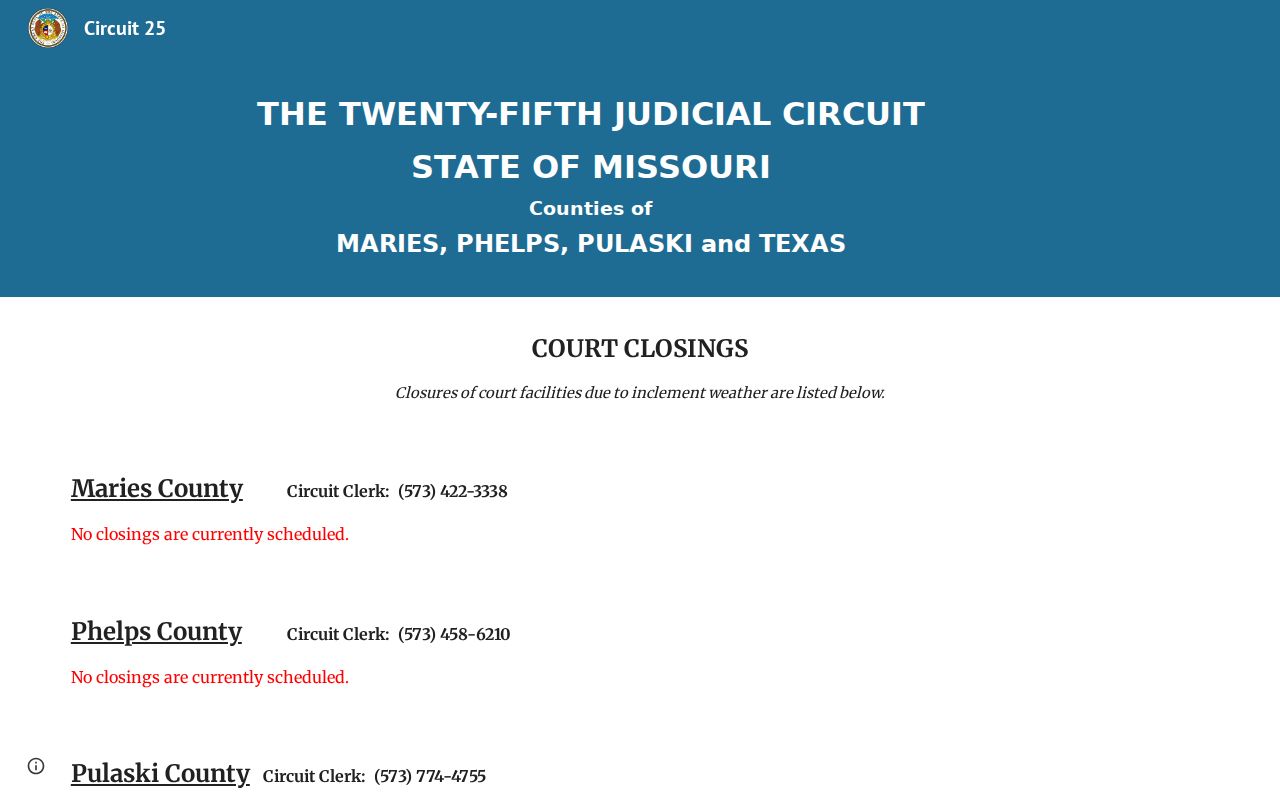
Whenever a closure or local announcement could affect a Pulaski court date, go to the current circuit source rather than an old screen.
Waynesville's official live feed carries the dated municipal-court cancellation example.
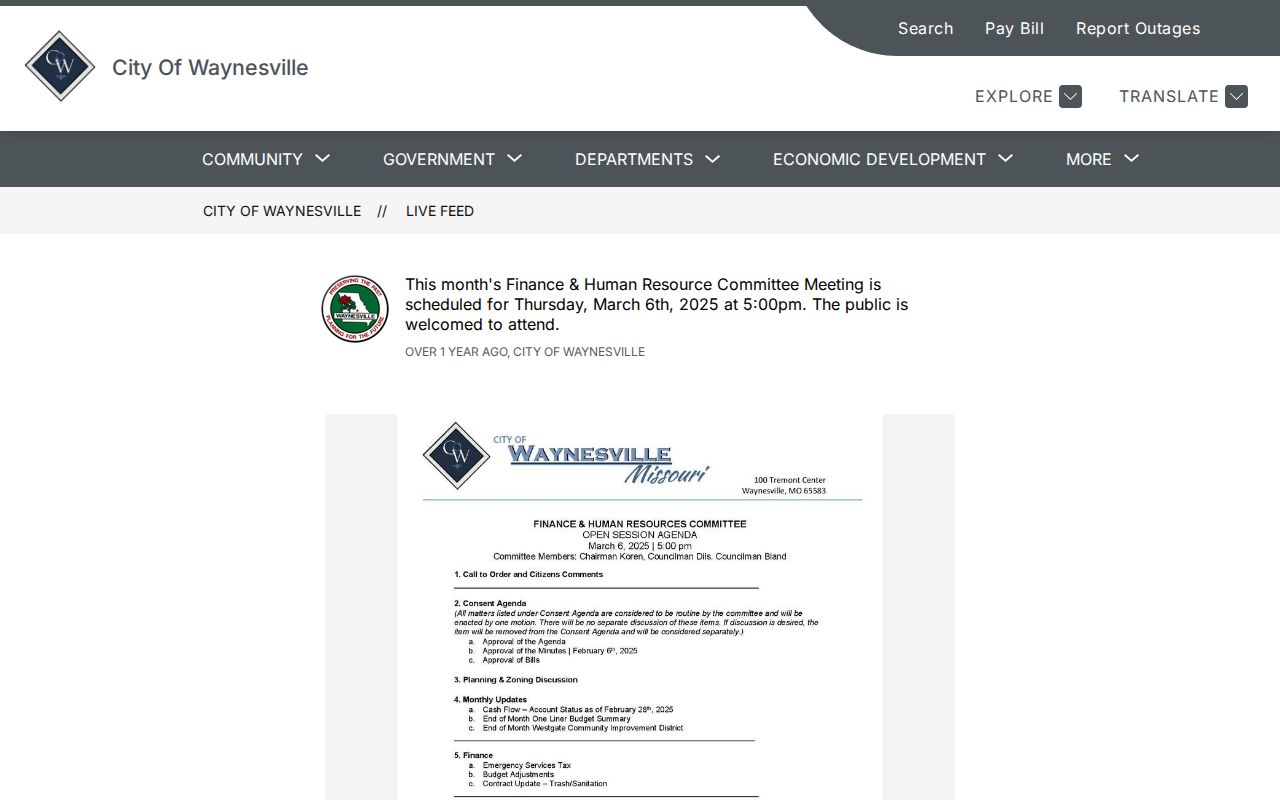
The city post reflects one past weather interruption. It sets no general rule for any current Pulaski court date.
If You Miss a Court Setting
Act fast and use the case-specific route. Recheck the notice, the Case.net case header, and the newest docket entries. Look for the listed setting and anything filed after it. Then contact the Pulaski County Circuit Clerk with the case number, case style, division, and the missed date. Reach a lawyer of record immediately. The clerk can confirm the docketed status and the correct record channel. But the clerk cannot tell you what legal step to take.
The consequences of a missed appearance depend on the case type, the notice, any court order, and later court action. In a criminal matter, a warrant-related entry needs current confirmation from an authorized court or law-enforcement contact. A calendar search will not do. And never assume a case was reset, dismissed, or closed. Not just because it dropped off one calendar result.
Missed a setting? Keep the notice and case number, review the newest docket entry, and contact the responsible clerk or lawyer without delay.
Ask whether the docket records a new setting, an order, or another action, and use the notice or court’s direction for any next appearance.
Pulaski Court Date Jurisdictions
Pulaski County court-date searching splits into state, city, and federal paths. State circuit and associate matters generally run through Case.net and the Pulaski County Circuit Clerk. Municipal matters can follow a city-specific route. Those routes have shifted recently. Dixon's official notice says its municipal court closed effective December 1, 2023. City case questions now go to the Pulaski Circuit Clerk. St. Robert's 2024 ordinance election sent violations to the Pulaski County Associate Circuit Judge in Waynesville. Always verify the actual division for each case.
Federal cases never appear on the Missouri state calendar. Pulaski County sits in the Western District of Missouri, Southern Division. Federal calendar or docket questions go through PACER and the federal court's procedures. A state case number tells you nothing about a federal setting. A federal notice is not a state-court instruction.
The Western District Southern Division page covers the federal courthouse, hours, and entry restrictions.
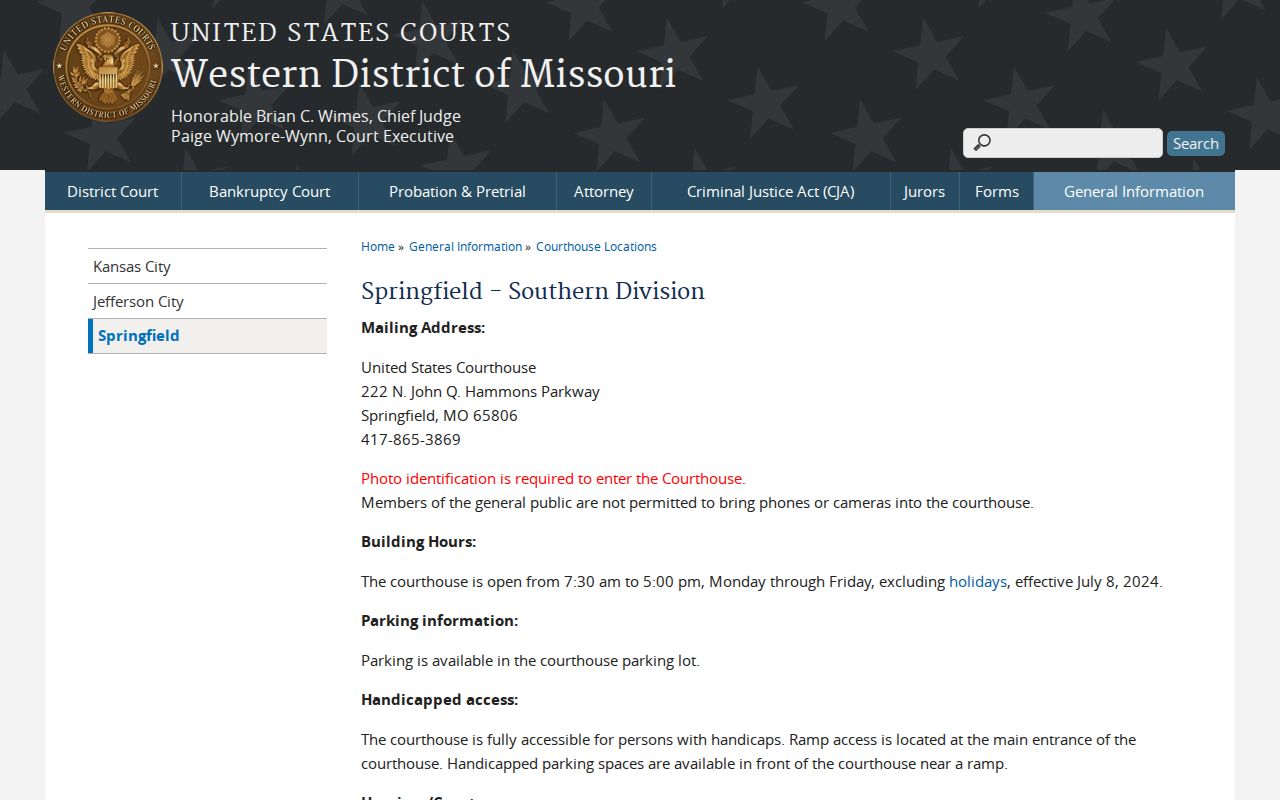
A federal court date works differently from a state one in Pulaski County. The federal courthouse keeps its own clerk. It has its own facility and its own access rules. So a date on a federal docket never follows the same path as one in Pulaski County state court.
Need an older state calendar copy, or material with no public setting? Send the clerk a narrow record request. State the case number, the date, the division, and the document you want, then follow the clerk's current mail, counter, or copy procedure.